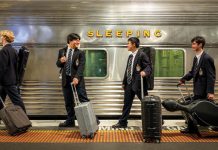
A recount of the State Debating team’s winning arguments.
Late last year, six Melbourne Grammar School students took to the Victorian State Debating Competition stage for the grand final against Huntingtower School.
The topic – that, assuming it was possible, we prefer time travel to space travel – was “unusually abstract” for this kind of contest, with Melbourne Grammar taking on the ‘negative’ argument.
“To solve this, we just tried to be equally abstract in our thinking,” team member Max Plenderleith says.
Debating arguments are typically structured into three parts:
What is the issue?
How does it arise?
How important is it to the main stakeholders of the debate, and why?
In the preparation room, Max (second speaker), together with teammates Antonio Hiscock (first speaker), Jonathan Zapris (third speaker), James Gao, Arten Singer and Tomorrow Zhang, homed in on the practicalities of space and time travel and their implications, while challenging each other with potential questions from the opposition.
They then took to the stage, and presented their key arguments as follows:
First speaker: The ‘butterfly effect’ of time (and the massive risks of time travel), and the possibility of bad actors using time travel to inflict harm on humanity.
Second speaker: How we cannot have ‘customs’ for time travel (because of its instantaneous nature) and hence the pertinent possibility of bringing archaic viruses back to life (that we are not prepared for/wouldn’t have known about).
Jonathan’s role as the third speaker was to rebut their opposition’s arguments, and to summarise their team’s points.
Max says that for speakers in this position, a common approach is to “spend time thinking about the claim that was made, the exact reasoning that was behind it (are there any fallacies?), and whether the implications of the claim actually benefit or inhibit the opposition and ourselves respectively.”
Each speaker is scored on ‘matter’, ‘method’, and ‘manner’. On their assessment, the panel of adjudicators found the Melbourne Grammar School team to be victorious in their arguments.
Max says that his involvement in debating has given him a more cohesive view on the complexities of world issues, given their commonplace in competition debating topics.
“I have come to understand that for every issue, there are multiple (imperfect) answers with different implications,” he says.
“No real-world problem has an absolute solution, rather, you just need to develop or find the best one possible.”
Max also says that debating has improved his speaking and reasoning skills, “especially in secret topics where one cannot rely on the ‘crutch’ of statistics to support an argument,” he says.
While personal opinions are typically set aside for competition debating, Max says that if he were to consider it, that he thinks time travel would have more benefits for humanity, “in the possibility of going back and fixing our mistakes,” he says.
“However, this would only be possible in the utopia that no one chose to use time travel for corrosive purposes, and that sadly is not the perfect life we live in today.”
Max says that he would also prefer time travel to space travel because he often “gets really bored on long haul flights” – something that he admits would have been exacerbated, hypothetically, if he were to space travel to Mars.