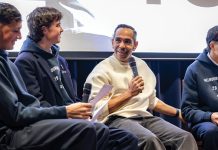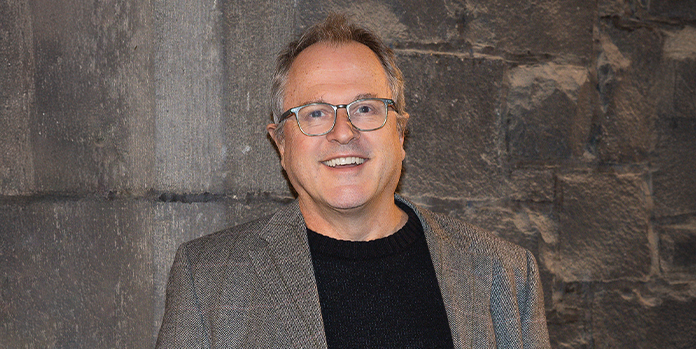
An excerpt from the Community Speaker Series oration by award-winning writer, actor, teacher, and director Humphrey Bower (OM 1980), delivered in August 2026 at Melbourne Grammar School.
The German Jewish writer Walter Benjamin wrote in his classic 1936 essay The Storyteller that the reader of a novel “warms his [or her] shivering life with a death he [or she] reads about”.
Rest assured that I don’t propose to tell you the story of my death to keep you warm. In fact, I don’t think Benjamin was really talking about death so much as the transformative power of storytelling.
For me, theatre has that same power of transformation: it transforms the performer, the space, and the audience, as well as the text itself.
As the impact of Christopher Nolan’s retelling of The Odyssey attests, ancient stories still have the power to move and mobilise us in all sorts of ways. As it happens I think his film – and the controversy surrounding it – is as much a story about our own time as Ancient Greece.
Like lots of people I was introduced to storytelling by my parents – especially my father, who used to tell me stories about mythological and Biblical heroes like Odysseus and Samson. He also told me stories about his own odyssey as a Jewish refugee from Vienna who emigrated to Australia in 1939.
He also told me the almost equally dramatic story of how my parents (who were both already married) met and fell in love (and finally divorced their respective spouses) in 1950s Melbourne.
On my mother’s side, there was the story of her own parents, who eloped to Australia from England against the wishes of both their families after the First World War. My grandfather was wounded at Gallipoli and on the Western Front, which is how he met my grandmother in a military hospital in England where she was a Red Cross nurse. She followed him back to Australia, and he became a soldier settler on a block of land in northern New South Wales, where my mother was born.
My parents both had a flair for the dramatic, and loved literature and the arts, and I grew up in a house full of books, music and lively conversations about politics and culture. They were both professionals – he was a psychiatrist, and she was a journalist, a TV producer and later an arts administrator and bureaucrat, who became the first Chair of the Community Arts Board of the Australia Council for the Arts (as it used to be called).
They sent me to Christ Church Grammar, and then to Melbourne Grammar, where I encountered the teachers and mentors who fostered my love of literature and encouraged me to become an actor.
In my first year at Senior School I was also a contestant for the first Sir Kingsley Norris Oratory Award. I won the competition the following year; and gave a guest speech the year after about ‘Living With A Psychiatrist’, which was my first attempt at standup comedy (and which my mother particularly enjoyed).
My teachers also gave me a lot of opportunities to read aloud in class. I especially remember reading the role of the loudmouthed bigot Alf in Alan Seymour’s play The One Day Of The Year, and the role of Hamlet when we read the whole play aloud over a couple of weeks in my Year 12 English Literature class with Ross Clayton.
I read large chunks of The Iliad in translation aloud in my Year 12 Classical Civilisation class. The other students probably got sick of the sound of my voice, but it was good training for what later become another major strand in my work: narrating audiobooks.
I think one of the things that theatre and storytelling have taught me – sometimes painfully – over the years is to understand my role, in every sense; not only in a play, but beyond that, in a rehearsal room, or a classroom; and beyond that, in relationships, or as a parent. On the other hand, you are never completed subsumed by your role or type: that would be a form of madness. As psychanalysis teaches us, we never completely know ourselves.
Audiobook narration is not for everyone – lots of actors struggle with the intense focus and long hours in that little recording booth with only the sound engineer and an imaginary audience to keep you company – but for me it gets to the heart of storytelling in its most basic form, much like reading to your kids or being read to as a child. In fact I’ve probably had more fan mail from audiobook listeners than anyone else, which I think is testament to the intimacy of the genre.
Why do I think theatre and storytelling are important?
In no particular order:
- Imagination and empathy: being able to (literally) walk in someone else’s shoes
- Putting conflict safely onstage
- Withholding judgement
- Tolerating uncertainty and ambiguity
- Connecting with others, with your imagination, with your impulses, with your emotions, with your body, with your voice, with yourself
- Listening and being present
- Collaborative enterprise
- Creating a community
Stories give our lives a sense of meaning and purpose.
About the Community Speaker Series
Held once per term, the Community Speaker Series aims to inspire meaningful discussion, promote intellectual curiosity, and spark
new ideas.
Each event features a different speaker who is invited to share their insights in their field of expertise on current topics and themes that shape the world around us.
These events are free and open to all members of the Melbourne Grammar School community.