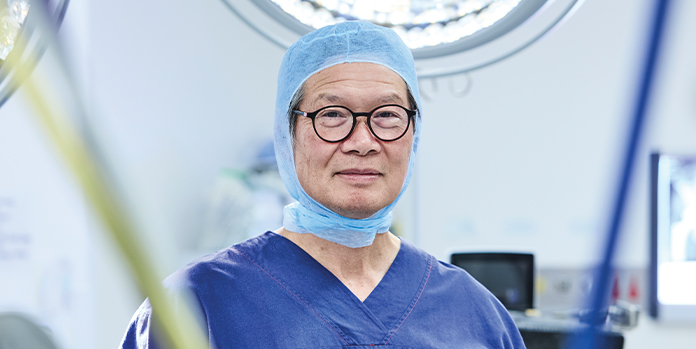
Standing outside the operating theatre at St Vincent’s Hospital in Fitzroy in head-to-toe surgical garb, orthopaedic surgeon Professor Peter Choong AO (OM 1978) lights up talking about the joy he’s found in the sport of dressage.
“It’s as much about the horse as it is about the rider,” he says. “That’s why you can change riders during a competition, but you can’t change the horse.”
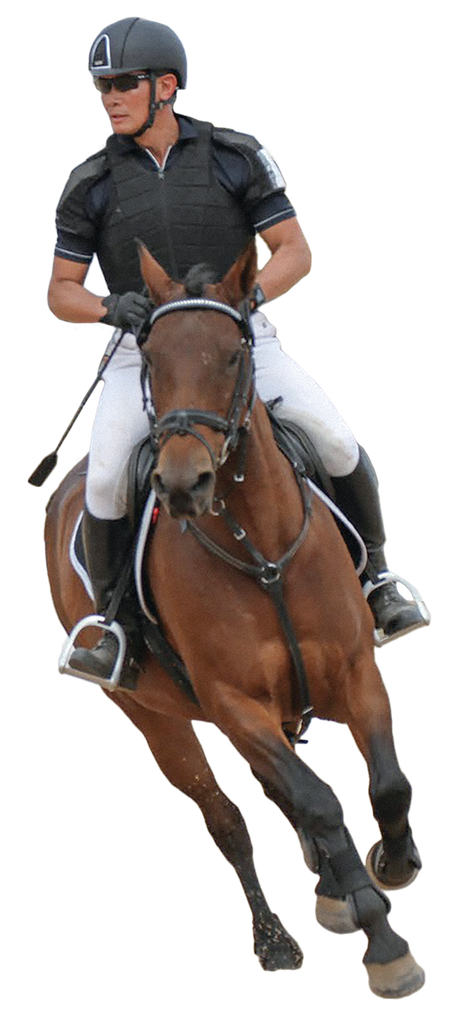
He goes on to describe the tiny, subtle movements used to communicate with a horse during competition, and it’s hard not to draw parallels to the absolute precision of surgery.
In the throes of a busy surgical career, Peter discovered his passion for dressage and eventing later in life, and by chance. Accompanying his daughter at one of her riding lessons, an off-handed comment from the instructor saw him take the reins and discover a new passion within himself. Now, they travel to Spain together annually to train at an international riding school.
Across both his personal and professional life, Peter has an overt curiosity for finding new, different, and better ways of doing things.
“While I spend a lot of my time caring for people and curing their diseases, I have a real interest in thinking deeply about what I do,” he says.
Every couple of weeks, he meets with a colleague for coffee to “shoot the breeze” on problems they’re facing, and big, blue-sky ideas. His recent focus has been on the “wicked problem” of arthritis.
As Peter describes it, arthritis begins as a “pothole” in the surface of your joint, and as it’s rubbed across, it, like a pothole on a road, wears down, and the hole gets bigger.
“There’s no cure for it,” he says. “You can’t stop arthritis, as it were, because once you get it, it’s one of those ongoing things that degenerate. And so, ultimately, when people have bad arthritis, you’ve got to exchange their joint for an artificial one.”
At one of these meetings, he recalls musing on the topic and dreaming up a pen that could “print” cells to regrow the cartilage to cover said pothole, “as if the original damage never happened”.
That idea progressed, and Peter and his colleague successfully developed a pathway to bring principles of tissue engineering into the world of cartilage repair.
Peter describes himself as an academic surgeon, with a career spent at the intersection of surgery, leadership, research, and innovation. In 2022, he was honoured as an Officer of the Order of Australia (AO) for his significant service to orthopaedic surgery, research, medical education and professional societies. His current roles include Honorary Enterprise Professor at the University of Melbourne.
More recently, his interest shifted into understanding how meaningful healthcare innovation happens – “not simply through discovery, but through leadership, collaboration, translation, enterprise, and the courage to rethink traditional systems,” he says.
As part of this, he believes strongly in never be satisfied with the “status quo”.
“Sometimes,” he says, “the status quo means you’re the best.
“And when you become the best at something, you defend that position strongly, and you apply the same formula because that formula got you to the top.
“But that means you stop innovating. You stop thinking how can you do it differently.”
When he was a child, Peter and his family migrated from Malaysia, initially settling in Noble Park. He commenced at Melbourne Grammar at Wadhurst in Year 7.
Of his time at Wadhurst, he recalls one robust lesson on ice and glass with a particularly enthusiastic Science teacher, Mr Kelso; one of many that sparked an interest for him in the discipline.
“As he was talking to us, he was playing with a cricket ball in his hand,” he says.
“Suddenly, he turned around and threw it as hard as he could at the window, and of course, it bounced off because we hadn’t appreciated that our classroom resided right next to Wadhurst Oval.
“That was his opening to talking about the concept of reinforcement.”
Peter says that it was those teachers who were “larger than life” and found different ways of reaching out, connecting, and communicating that really made an impact.
An aspect of his Melbourne Grammar education education that Peter particularly appreciated was the mandatory nature of sport.
“If there were any differences on the sporting field, it didn’t matter anymore because you were all there together, united for a single purpose,” he says.
And as he’s become more senior in his roles, one of the things Peter says he has enjoyed most is bringing people together.
“You realise soon enough that you can’t solve big problems on your own,” he says.
“Just like it takes a village to raise a child, it takes a village to build success.
“In my world, translating research discoveries into impact relies so much on different people and being prepared to look beyond your own neighbourhood.”
Peter says that his experiences working in and growing teams have drastically changed the way he approaches his work.
“I’m no longer satisfied with just a discovery – I want to translate it into something that can make impact,” he says.
“I’ve gone from being someone who’s just a doctor – to questioning how I can treat things better – to looking outward into areas that I wasn’t trained in, and bringing people in that I would not normally interact with.
“You’ve got to create situations that challenge you mentally, emotionally, physically, to think differently, and to do the sorts of things that help us build a better world and help people be the very best selves of themselves,” he says.
“That’s how history is made.”
There are three tenets that Peter swears by; to live curiously, to think deeply, and the third, which he credits to his time at Melbourne Grammar School, is to “share generously”.