It’s no small feat to try your hand at solving one of Australia’s most pressing health problems, even hypothetically.
The Global Health Youth Connect Case Competition is an inter-school contest run annually by medical students at the University of Melbourne.
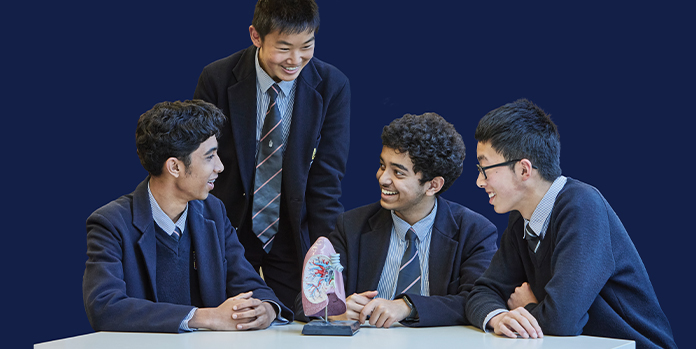
Year 10 students Daivik, Jack, Syon, and Lachlan were up against 50 teams from over 35 Victorian schools, each tasked with tackling the same complex issue; Chronic Obstructive Pulmonary Disease, or COPD.
“Rather than trying to immediately design a solution, our team started by examining the problem itself,” explains Syon.
“We looked at the limitations of current treatments, who is most affected by the disease, and where an intervention would have the biggest impact. We wanted to come up with a solution that was innovative and practical, and could be accessed by as many people as possible.”
The Year 10 team worked intensively to understand how COPD could be better treated, iterating on their ideas as the competition progressed.
The final challenge was to develop a 10-minute presentation that condensed all the details of their research into a clear, engaging narrative, which saw them awarded with the winning solution.
“The concept we came up with only emerged through many cycles of brainstorming, research, feedback, and critical evaluation,” Syon says.
“We had to keep reconsidering our assumptions. It was relatively easy to imagine what an ideal solution might look like, but the more difficult task was deciding whether our idea could function out in the real world.
“We had to think about practical limitations, and modify our approach with that in mind.”
The Year 10 team’s solution tackled COPD from multiple angles.
First, they developed a prototype for a risk assessment app, which would be connected to users’ medical histories and include input from GPs.
Next, they came up with the idea of “accountability buddies” who could help those trying to give up smoking with instant peer support.
They also pitched changes to the Pharmaceutical Benefits Scheme that would address geographic and social inequality, extending subsides for nicotine therapy.
To complete their presentation, Daivik, Lachlan, Jack, and Syon mapped out a three-year implementation timeline, costs, and potential short and long-term impacts.
Syon says the experience of the competition proved that meaningful ideas are cultivated through persistence and refinement, rather than instant “lightbulb moments”.
“The competition showed us that innovation requires more than creativity,” he says.
“It called for curiosity, critical thinking to recognise weaknesses, and persistence to keep refining until your idea can stand up to scrutiny.
“I think this is a mindset we’ll take back to the classroom.”