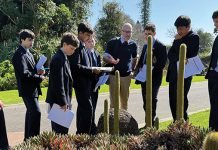
“Debating and public speaking go hand in hand with English teaching,” says Ellie Parker, Wadhurst’s Debating Coordinator and Acting English Coordinator.
“Both are about the power of the voice, and of turning our words into messages that have impact.
“I love seeing students have that moment of realisation, when they understand that their voice has value. It’s quite a powerful moment to witness.”
Ms Parker’s work spans the Humanities curriculum at Wadhurst and the Senior School, with a particular focus on English. Alongside her teaching, she has been the Wadhurst Debating Coordinator for almost two years.
“Being part of debating has been a fantastic way to see students build confidence and skills over time,” she says.
After completing her teaching qualification in Ireland, Ms Parker taught in the UK and Sydney before coming to Melbourne, and has been teaching at Melbourne Grammar for two years.
“One of the aspects of teaching here that stands out to me most is that we place a strong emphasis on relational learning, and on building strong connections between staff and students,” she says.
“Students know that what they have to say will be listened to, and that it matters to us.”
Working with students who have varying levels of comfort with public speaking, Ms Parker emphasises that a gradual approach to the practice is important.
“Often when we meet our Year 7 students, they are just starting to find confidence with public speaking,” Ms Parker explains.
“We begin in the classroom, where students start giving voice to their ideas. These smaller moments of sharing their thoughts out loud progress to presenting to a small group, then to the whole class.
“This might lead on to speaking at House meetings and assemblies, and finally to debating, when students are voicing their arguments in front of a totally unfamiliar audience.”
Keenly aware of the changes in digital technology that are influencing her students’ learning, Ms Parker says that teaching students how to communicate effectively has only grown in importance.
“Effective communication enables our full participation in the world,” she says.
“Students may occasionally fall into the trap of taking the shortcuts AI tools offer, but those larger communication skills are still vital to their ability to make a meaningful contribution.”
Ms Parker adds that from the beginning of her time at Melbourne Grammar, she has noticed a culture of voice fostered across the community.
“This school encourages students to express what matters to them in a meaningful way,” she says.
“This is something that will always benefit them, whether they’re advocating for themselves, celebrating others, or speaking out when they feel something isn’t right.
“We teach students to be upstanders rather than bystanders. The work we do together gives our students the skills, words, and tools to make sure their voices can be heard.”