Just before sundown on a beautiful autumn evening in Mount Rothwell, Unit 3 Environmental Science students were rolling up their sleeves to mould together clumps of peanut butter and sardines.
These would be used later in the night to entice local, endangered species, such as the southern brush-tailed rock wallaby, the eastern barred bandicoot, and the eastern quoll, to collect data to aid in local conservation efforts.
“First, our students learned how to set up camera traps, and we discovered how these are used to track animal health and population levels,” Science Teacher Mrs Kirsten Walker explains.
“Once night fell, we went out spotlighting to count different species, and our totals were added to the park’s database.
“Any animals caught in our Elliott traps were checked and weighed, and observations about their health were recorded with the guidance of the park’s scientists.”
A cross-disciplinary subject, Environmental Science draws on chemistry, biology, physics, geography, and even elements of legal studies and maths, all while bringing students into contact with real-world conservation challenges. Fieldwork excursions like this are a way to bring students into contact with real scientific methods.
“We learned about how scientists follow certain protocols to make sure the animals aren’t harmed in any way,” Year 11 student Angus Syme says.
“It was amazing to get so close to the animals when gathering our findings, and it feels good knowing our findings and data will contribute to protecting the environment.”
Communicating scientific findings is an essential aspect of working as an environmental scientist, and this is another area where students have opportunities to emulate professional experiences.
As a faculty, Mrs Walker says, their aim is for students to “learn to be, rather than learn about.”
“Everything we learn mirrors what environmental scientists are actually doing, and everything we teach draws on current case studies,” she says.
“When students return from an experience like the Mount Rothwell excursion, they take responsibility for sharing their findings with their peers.
“It’s really powerful for students to see themselves as the expert in the knowledge they have collected, and this gives them a strong sense of leadership and agency in their learning.
“Getting outside and learning in hands-on ways can be incredibly empowering.”
Similarly, in Year 8, Geography students have been deeply immersed in an elective wildlife conservation unit called ‘Endangered Species’. Students travelled to Werribee Open Range Zoo to learn first-hand about local and global conservation programs before creating their own conservation documentaries.
To conduct their research, students learned to use geospatial, mapping, and documentary production tools used by environmental scientists, researchers, and other industry experts. Using this technology, they were able to combine maps, data, and multimedia to communicate their findings.
“Developing these skills provides students with valuable experience in technologies that are increasingly shaping the jobs of the future,” Geography Teacher Georgina Birch says.
Jack Yuan (Year 8), who focused his documentary on Tasmanian devils, says that he particularly enjoyed using his new-found skills to communicate important messages, effectively.
Henry Partington (Year 8) also highlighted the value of this skillset, noting that by having learnt to make a documentary, he will be able to teach people how to help and improve outcomes for endangered species worldwide.
“I know that I may not be a politician or David Attenborough, but I know that I can still make a difference.”
Across these endeavours, students remain connected to the School’s broader priorities: to embrace the wider world, and to serve and engage with their communities.
For both teachers, their goal is for students to come away from the subjects feeling more connected to the world around them, and more confident in their ability to think critically about environmental issues and the natural world.
“I also hope students continue to consider the environment and their impact on it in whatever future path they choose to follow,” Mrs Walker says.
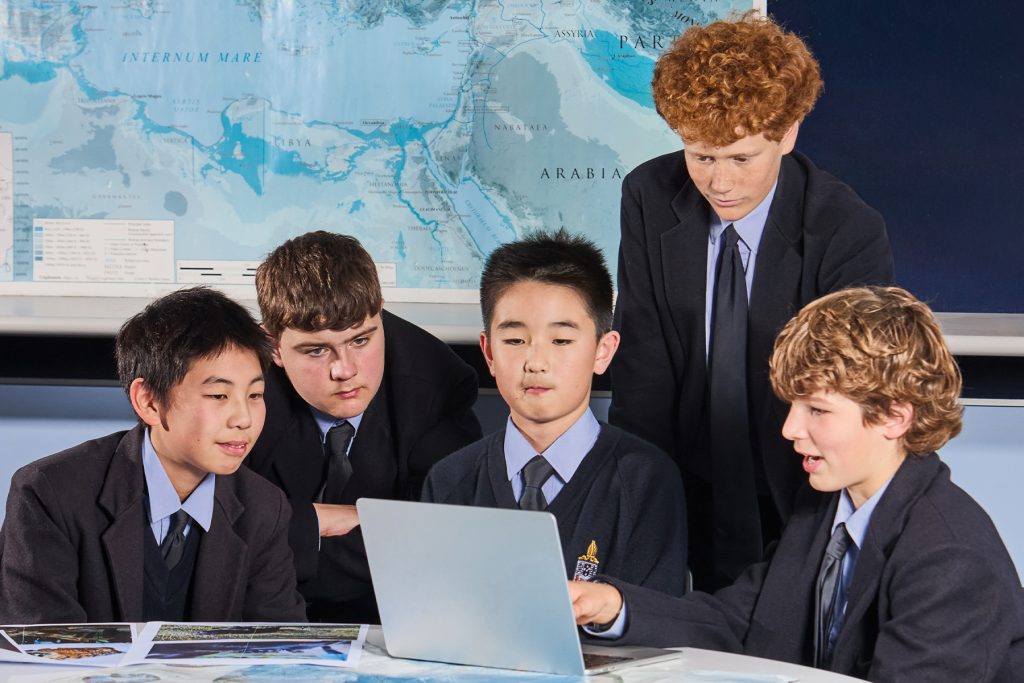
Left to right: Jack Yuan, Henry Partington, Ethan Zhang, Wyatt Cameron, Jimmy Harley