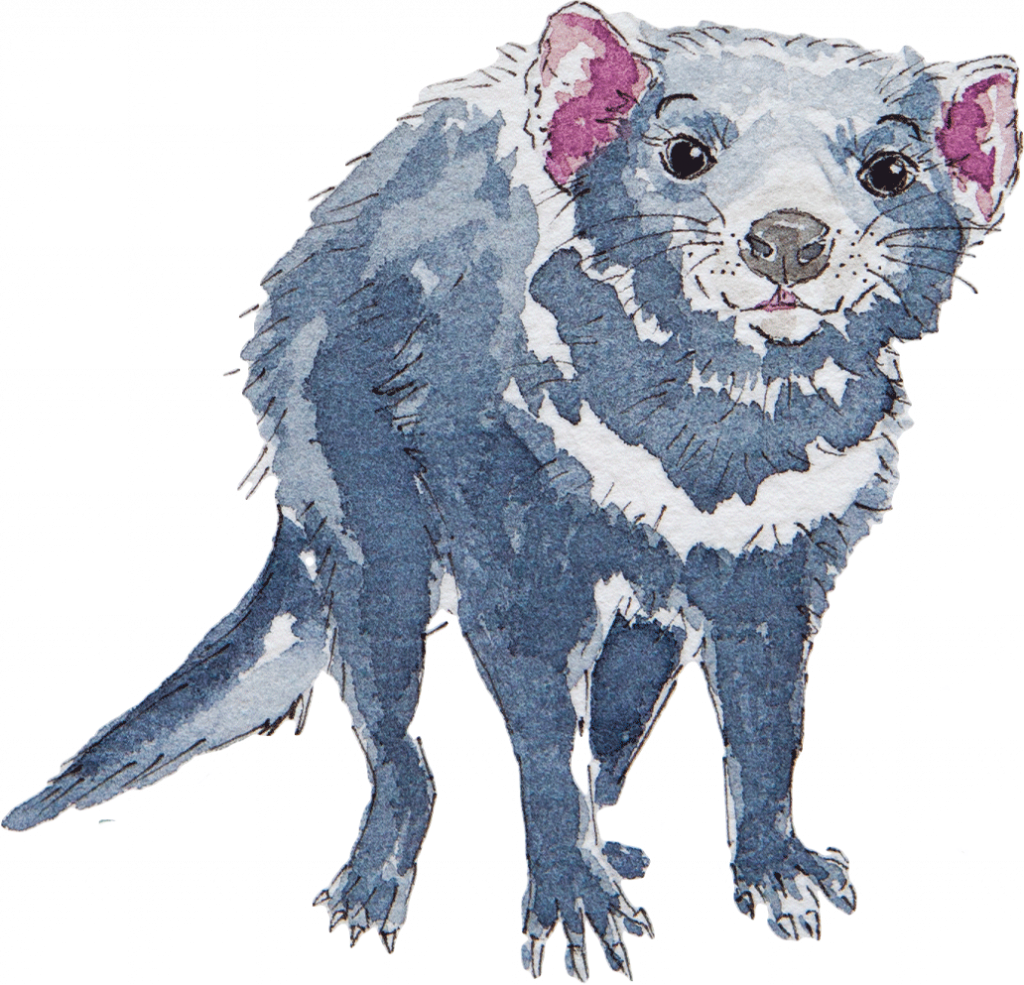
In the early 2000s, Emeritus Professor Dr Hamish McCallum (OM 1974) was working as an Associate Professor in the School of Biological Sciences at the University of Queensland.
Then, “this weird infectious cancer turned up in the Tasmanian devils.”
So, in 2006, Hamish relocated to Tasmania as Chief Scientist on the Save the Tasmanian Devil Program. Working closely with geneticists and field scientists, his role was to mathematically model the spread of the cancer through the population to help understand its behaviour.
Hamish describes his field of mathematical ecology as “taking mathematical tools and concepts to try to make sense of the natural environment.”
He uses differential equations to model and link quantitative approaches and theory to situations and problems. Across his extensive career, his work has focused on mammals, birds, amphibians, reptiles, fish, and echinoderms, and in habitats ranging from coral reefs to temperate forests and deserts.
After first appearing in 1996, the Tasmanian Devil Facial Tumour Disease spread through most of Australia’s southernmost state, reducing population numbers by around 80 percent and threatening the species with extinction.
“I think the best way to explain it is that almost all cancers are your own cells gone crazy,” Hamish says.
“When we started looking at the Tasmanian devils, the weird thing was that the cancers that they had were genetically different from the devil that they were infecting, so they weren’t their own cells gone crazy, they were somebody else’s cells,” he says.
“The devils bite each other, and some of the cancer cells get transferred in the biting process, and then they’ll sort of grow like a parasite, if you like, on the other devil.”
Because it was such an unusual cancer, Hamish says that it created interest from a range of scientific experts, including conservationists, geneticists, and cancer and evolutionary biologists.
“Because of this property that it can survive the host death, it gave insight into the processes that regulate cancers in general,” he says.
Hamish says that when the cancer first appeared, they would “never” see a devil recover if it had a tumour on its face. But, over time, the scientists started seeing some tumours getting smaller, and some devils surviving.
“The good news is we don’t think that the tumour will send the devils extinct, which we thought it might 15 years ago,” he says.
For conservationists, Hamish says, this is great news. Following the extinction of the Thylacine (Tasmanian tiger), the Tasmanian devil is the largest surviving marsupial carnivore.
“What we were doing is of fundamental interest to evolutionary biology as well, because it’s an example of how quickly evolution can occur.”
Despite the lack of genetic variation in Tasmanian devils, in as few as five generations, scientists have seen the devils evolve to have some resistance to the tumours.
“Everybody imagines that evolution is a very, very slow process,” Hamish says.
“But if you put enough evolutionary pressure on a population, it can be quite quick.”
After three years in Tasmania, Hamish returned to Queensland to take up the role of Head of the School of Environment at Griffith University, where he continued to work on infectious diseases, including a “very nasty fungus” that was killing off Australian frogs, called the chytrid fungus.
Another project that drew his focus was the Hendra virus, which “spilled across” from bats into horses, onto humans, where it causes more than 50% mortality.
“We discovered quite a number of interesting things about Hendra,” he says.
“In particular, we learnt that disturbing natural environments drives the bats from their natural habitat.
“What they ought to be eating is pollen and nectar in native bushland, but if you destroy the bushland, they then move into the suburbs, they start feeding on people’s fruit trees, and if they’re in the same places as horses, then you get the spillover.”
Similarly, Hamish says that we can expect climate change to cause major issues with emerging infectious diseases, some of which we’ve already seen.
“Climate change is enormously important for all biology and for the human race, but for infectious diseases it’s very important as well,” Hamish says.
“When a pathogen encounters a host it has never been exposed to before, it tends to have a severe impact. What is happening with climate change is that it’s causing different species and their diseases to shift their ranges, and that’s bringing species in to contact that have never seen each other before.”
Now “gone Emeritus, as they say,” Hamish reflects fondly on the opportunities his career brought him to spend time in nature.
Hamish was the 1974 Academic Head of School at Melbourne Grammar, performing exceptionally well across maths and sciences.
“But,” he says, “my passion was always in the environment and field work.”
He recalls fond memories observing mammals and birds with the Field Studies Group at McMichaels Hut in the High Plains, and credits this experience as one of the stronger influences that set him on this career trajectory.
“One of the nice things about my work in Tassie was it took me to virtually every corner of the state, and one of the things that was great about my time at Melbourne Grammar School was the outdoor education program, when I first got into hiking.
“When I went back to Tassie, I got back into it and did most of the major hikes. It was recreation, really, but of course we’d look out for devils when we were out there!”
Now living in St Kilda, Hamish still contributes to the field, and is currently working with colleagues from Oxford on a project that is looking at predators and their effect on evolution.
“There’s a population of silver eyes (small birds) on Heron Island where they’ve got no predation. There are populations on the mainland where there are lots of predators, and we’re looking at the way in which that’s affected their evolution.
“That’ll keep me going for another three years or so,” he says.
“And I still am involved in the devil research.”
Looking back across his career, Hamish says that the thing he is most proud of is the postdoctoral and PhD students he has supervised and mentored.
“They’re doing great things all around the world,” Hamish says.
About Dr Hamish McCallum
Hamish studied a Bachelor of Science (Honours) at Monash University, followed by a PhD at the University of London and a Diploma of Imperial College, supported by a prestigious scholarship from The Royal Commission for the Exhibition of 1851, awarded to only nine people across the British Commonwealth each year.
During his time in the United Kingdom, he studied under Sir Roy Anderson, who at the time was a junior lecturer researching parasites, and is now known as a leading international authority on the control of infectious diseases. Anderson and well-known Australian scientist Lord Robert “Bob” May, who is known for bringing physics to the field of ecology, together developed the field of mathematical epidemiology.
When Hamish was a PhD student at Imperial College, he has fond memories of spending time with Bob, who would travel from Princeton to the UK each year “to play croquet amongst other things.”
Years later, this field of research was at the forefront of the response to the COVID-19 pandemic.