While surveying the then-unexplored Antarctic coast, polar explorer John Riddoch Rymill (OM 1922) wrote in his diary;
“As we sledged along I was impressed by the thought that here was all this strange grandeur round us, and we – people of the twentieth century… were the first to see it since the world began.”
John was born in 1905 in Penola, South Australia, and was later educated at Melbourne Grammar School as a boarder, along with his older brother Robert (OM 1922).
At School, the stories of visiting Old Melburnian adventurers such as B A Armytage (OM 1886), H D Murphy (OM 1890), and E F R Bage (OM 1904), veterans of the Shackleton and Mawson expeditions respectively, provided students like John with inspiring examples of scientific discovery in the polar regions.
John’s early fascination with the topic was complemented by a strong aptitude for practical mathematics – a skill that would later prove invaluable as he carved a deliberate path towards a career in polar exploration.
After graduating, John learnt to navigate and survey at the Royal Geographical Society in London.
In Essex, he learnt to sail, and in Switzerland, he learnt to ski and mountaineer.
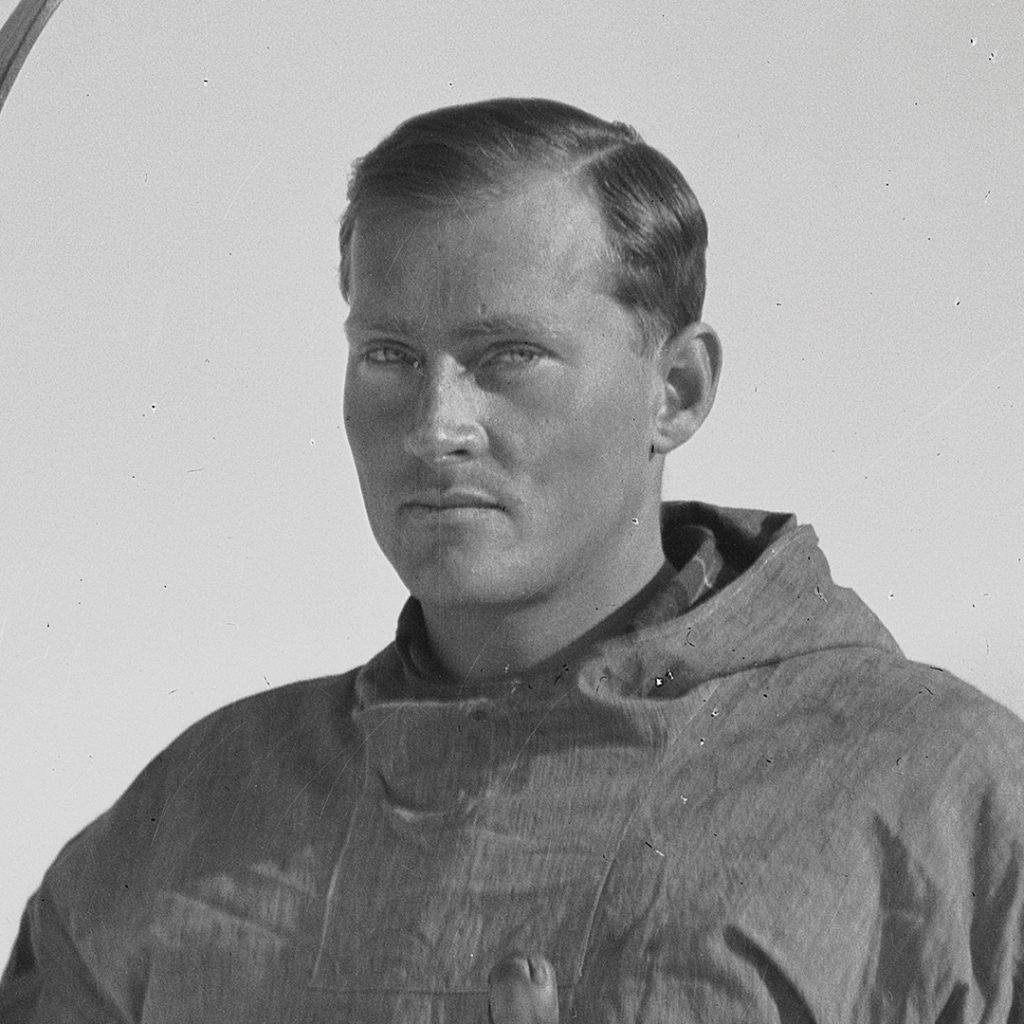
In 1927, he won the first-ever National Skiing Championship in Australia, held on Mount Kosciusko. Then in 1928, he obtained his international aviator’s certificate.
John’s first polar expedition was in 1930, when he joined the British Arctic Air Route Expedition in Greenland. The Headmaster’s report the following year revered John for his “adventurous spirit” and acknowledged his “self-sacrifice entailed, without hope of reward, for the advancement of scientific knowledge.”
Just four years later, he set out on what would become his most significant and notable adventure; the British Graham Land Expedition (1934–37).
The area east of Graham Land, the northernmost stretch of the Antarctic Peninsula, was originally thought to be an archipelago (a group of scattered islands).
Surveying nearly 2,000km of previously-unexplored coast, John and his 15 fellow expeditioners were multi-skilled and multi-disciplinary; crucial for survival in the harsh polar climate.
The expedition culminated in the discovery that this area was in fact a continuation of the Antarctic Peninsula, changing the way the world saw and understood the region.
In 1939, John returned to the School like those adventurers before him, speaking to Wadhurst students about his time in Antarctica, “illustrating by means of a special diagram exactly where he had been, and what lands he had discovered and charted from his aeroplane.”
John received a Silver Polar Medal for his discoveries, and his contributions to polar exploration have been internationally renowned.
Today, John Rymill Collections relating to his career are held by the Scott Polar Research Institute at the University of Cambridge, and the South Australian Museum.
Photos: The Scott Polar Research Institute, University of Cambridge