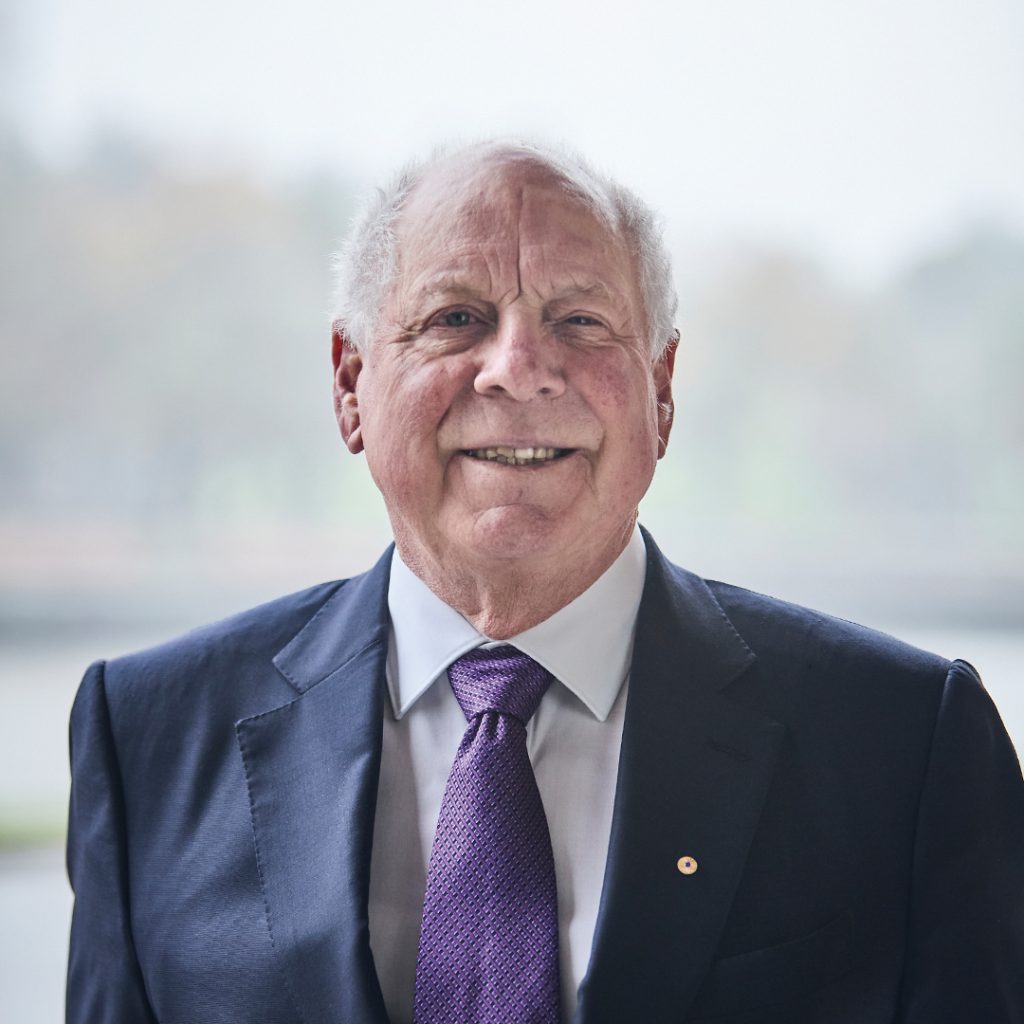
“In those early days of rowing, you would tend to bump your fingers on the sides of the boat a bit,” Andrew Michelmore AO (OM 1970) recalls.
“But, gradually, over time, when the boat sits up and it runs… it’s just magic.”
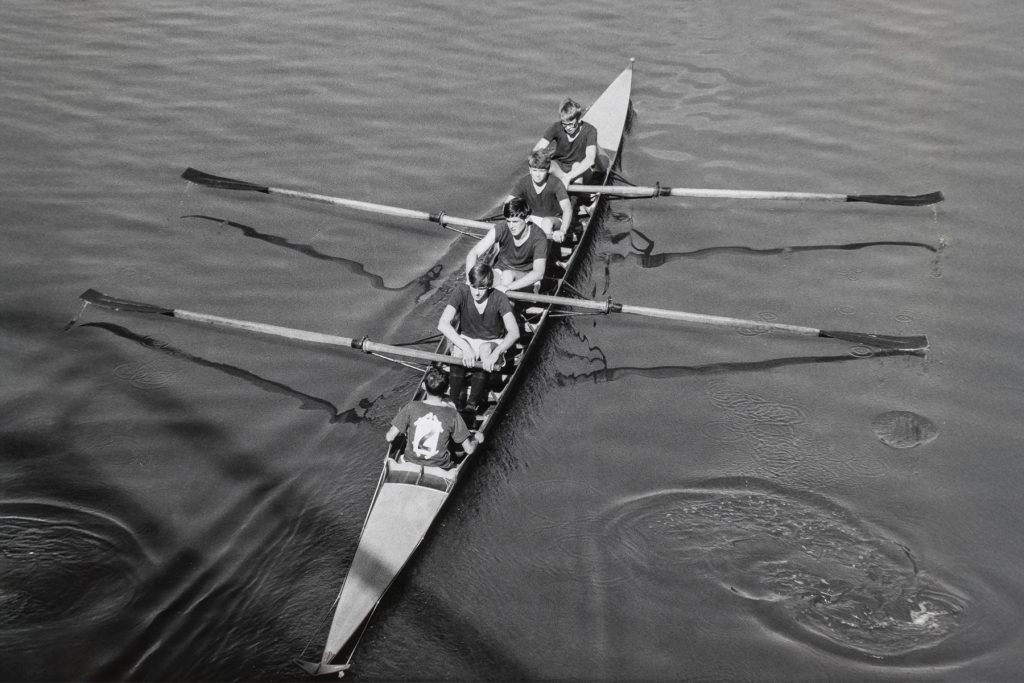
Andrew’s extraordinary professional and athletic career began, in many ways, in 1967, when he first set foot in the Simon Fraser Memorial Boat House. His older brother had rowed, and he didn’t count himself any good at ball sports, so he thought he’d give it a go.
He would go on to win Australia’s first rowing World Championship title – a gold medal at the 1974 World Rowing Championships in Lucerne with the lightweight men’s four.
Andrew’s first Head of the River (APS) regatta as a member of the First VIII was in 1969. Melbourne Grammar had won the year prior, and three from that crew were to row in the Firsts again.
“I was in the stroke seat, and so setting the rhythm,” he says.
“John Benson (OM 1969) was in the seven seat, and so between the two of us, setting the rhythm and the pace, and having this power coming in with you, it was like a silky, powerful machine.”
The crew didn’t win the race.
“But that was probably good for me for the longer term,” Andrew says.
“The thing I love about rowing is, if someone on another side beats you, they do it fairly. They’re either stronger, fitter, technically better, mentally better; more as a crew.”
In 1971, Andrew commenced an engineering degree at the University of Melbourne, and joined the Melbourne University Boat Club (MUBC). As a lightweight four, his crew won the Australian Championships before being selected to travel to Lucerne for their World Championship-winning row. They returned to compete the following year, coming home with a bronze.
With a Rhodes Scholarship under his belt in 1976, Andrew’s studies, and rowing career, relocated to Oxford where he read politics, philosophy, and economics. In 1977 and 1978, he rowed in the stroke seat for Oxford, winning the Oxford-Cambridge Boat Race both years. His final season in 1979 was back at MUBC, and was bookended with one final World Championship row in Yugoslavia.
A “hunger to be better” and a “love of competition” are characteristics that Andrew embraces; on and off the water.
When he was training with his lightweight crew, Andrew recalls racing heavyweight crews who were expected to beat them. They would do everything they could to hang on, and would, much to their counterparts’ surprise, compete to win.
His approach to competition always centred around the team; and the importance of embracing and committing wholly to a shared goal.
Andrew can draw many parallels between his career in leadership, and the dynamics he experienced in a rowing crew.
“The team delivers, not an individual,” Andrew says.
“These guys in the boat are all different characters. How do you get them to commit together? That’s business.”
Andrew’s professional career spanned 35 years in senior leadership roles in the metals and mining industry. He has also been the Director and Chair of the Clunies Ross Foundation, an organisation that advances the communication and application of science. A supporter of health and education, he also chaired the Jean Hailes Foundation for Women’s Health and Ormond College Council.
Having stepped down after six years as Melbourne Grammar’s Chair of Council, Andrew is now supporting the School in a different capacity, as Campaign Chair for The Courage of Ideas.
“My view of this role is to get people enthused, passionate, informed, and proud of themselves to join in on that giving side,” he says.
“That could be serving on Council or on committees, it could be helping to do some of the background work for fundraising, or giving themselves.”
Part of Andrew’s inspiration to continue his work comes from a deep understanding of the impact of his Melbourne Grammar School education, and the incredible effect it had on his life and career.
“If I hadn’t received a scholarship to Melbourne Grammar, I probably wouldn’t have rowed, I wouldn’t have had the coaches I had, let alone the teachers,” Andrew says.
“A couple of those teachers fed my hunger for problem solving, maths, physics, and particularly chemistry, and so that helped me with the academic side of my time at the University of Melbourne.
“If it weren’t for them, I wouldn’t have got a Rhodes Scholarship to Oxford, I wouldn’t have rowed in the Blue Boat, and then come back to Australia and started my professional career.
“You could keep going through all these bits and it’s a chain, and some of the things might have happened anyway, but I can link it all back to what started back here.”
While his rowing days are now behind him, Andrew hasn’t forgotten the joy he found on the water.
“There’s space, and there’s trees; it’s got this magic feeling to it, and the water, especially when it’s silky smooth, it’s just idyllic.
“I can’t go anywhere without looking at a river and going, what would that be like to row on? What would you see? How’s the water? Is it running? How wide is it?
“Just imagining rowing along; it’s magic, magic, magic.”